Bunnsies - Happy Pet World
- 4.0
- Rating
- 10.00M
- Installs
- Free
- Price

 Analysis by App-foxy
I found Bunnsies - Happy Pet World to be a gentle, child-friendly pet game built around caring for adorable bunnies rather than winning difficult battles or mastering complicated controls. It belongs to the educational game category, although I would describe its learning value as informal: it encourages attention, routine, observation, and simple responsibility through play. The central idea is easy to understand from the beginning. You hatch bunnies, collect them, look after them, and spend time with them through small pet activities.
That simple setup is also the reason I think it works best for first-time players. There is no intimidating opening screen or demanding tutorial to study. The game invites you to interact with cute animals, and the early experience is designed to feel approachable. TutoTOONS clearly aims this at families and younger players, but adults looking for a calm game to share with a child may also find it useful. It is free to start, rated Everyone, and has reached over ten million installs, so it is an established choice rather than an obscure experiment.
My overall impression is positive, with one important qualification: this is a routine-based virtual pet experience, not a deep simulation. If you want a relaxing activity with collectible characters and playful care tasks, it makes sense. If you expect a large story, complex strategy, or unlimited variety in every session, the format may feel lightweight after the initial charm settles.
You May Also Like

 Blood Strike: 2.5 Anniversary
Blood Strike’s Loadouts Turn Every Drop Into a Tactical Gamble
A close look at Blood Strike’s custom loadouts: how fast access to signature weapons reshapes its battle royale rhythm, rewards preparation, and narrows the gap between fights.

 Pandora - Music & Podcasts
Pandora’s Music Is Easy to Start, but Harder to Recover
Pandora’s strength is its low-effort path from a seed to a station. Its weak spot is how much confidence it asks you to place in connection, setup, and quiet recovery.

 8 Ball Pool
 Is Built on Rivalries, Rematches, and Routine
A close look at the rivalries, rematches, shared routines, and unanswered safety questions that turn a quick pool match into a persistent mobile community.

 Samsung Music
’s Quiet Strength Is Playing What You Already Own
Its reach comes less from spectacle than from dependable access to a personal library. That simplicity is both the app’s strongest retention engine and its ceiling.

 AccuWeather: Weather Radar
AccuWeather Review: A Quick, Clear Forecast for Everyday Decisions
For everyday plans, the best forecast is the one you can understand quickly. AccuWeather makes rain timing, radar, and local conditions easy to act on, with a few trade-offs.

 Hill Climb Racing
Why Hill Climb Racing Still Turns Crashes Into One More Run
A tiny car, a bumpy hill and one more upgrade: Hill Climb Racing keeps resurfacing because its simple chaos makes every near-miss feel personal.
More From Our News Desk



What the first few minutes are really like
When I approach a game like this, I want to know whether the first meaningful action arrives quickly. Here, the answer is yes. The appeal comes from seeing a bunny appear, responding to its needs, and learning how the different parts of the pet world connect. The game does not ask a new player to understand a large rule system before having fun. Instead, the animal itself provides the motivation to keep exploring.
The collection element gives the experience a clear long-term direction. One bunny can be enjoyable on its own, but the possibility of discovering and caring for more animals gives children a reason to return. That structure is especially suitable for short sessions. A child can open the game, check on a pet, complete a small activity, and stop without needing to remember a complicated mission or reach a distant checkpoint.
I also like that the game communicates through visual feedback. Cute expressions, bright presentation, and direct interactions are easier for younger players to follow than text-heavy instructions. This does not make every screen self-explanatory, but it lowers the barrier to entry. A child who is still developing reading confidence can understand much of the experience by watching what the bunny does and trying the obvious interactive elements.
The educational label should be understood in that context. I would not use this as a replacement for a dedicated learning app covering reading, mathematics, or science. Its value is closer to guided play. It can help a child practice patience, remember a repeated care routine, and think about how an action affects a virtual pet. Those are modest benefits, but they are more believable than treating the game as a formal lesson.
Starting without making the setup feel like homework
The first setup is straightforward: install the game, open it, and let the early prompts guide you toward the bunny interactions. I recommend that a parent stay nearby for the first session, not because the game is difficult, but because a child may ask what an icon means or why a particular activity is available. A few minutes of shared exploration is enough to establish the basic rhythm.
Before handing over the device, I would also decide whether the child should be allowed to make purchases. The game is free to download, but it includes optional in-app purchases ranging from $1.49 to $159.99 per item. That range makes device-level purchase controls especially important for a family device. The presence of optional purchases does not prevent casual play, but it does mean that “free” should be treated as a starting point rather than a promise that every part of the experience costs nothing.
Another practical step is choosing a comfortable session length. The game is easy to dip into, yet collectible pets can encourage a child to continue asking for “one more” activity. I find it works better when the child knows the plan in advance: check the bunny, try one or two activities, then put the device away. That turns the game into a small routine instead of an open-ended source of screen time.
The current version is 1.6.198, and it runs on Android starting with version 6.0. For someone using an older phone or tablet, checking compatibility before planning a family session is sensible. On a supported device, the more important question is not technical complexity but whether the screen is large enough for a child to tap comfortably. A bigger tablet can make the pet interactions easier for small hands than a compact phone.
The first successful action to aim for
For a new player, I would define success very simply: hatch or meet a bunny, complete a care interaction, and then try a pet activity without asking an adult to take over. That sequence teaches the basic loop better than rushing to collect everything. The child learns that the bunny is not just a picture to unlock; it is a character to check on and engage with.
I suggest letting the child choose what to do next whenever the game presents a clear choice. That small decision matters. Instead of turning the session into a demonstration where an adult taps every button, the child begins to understand the game as a space they can navigate. If the first attempt goes wrong, I would treat that as part of the discovery process. The low-pressure design makes experimentation less frustrating than it would be in a competitive game.
A useful family routine is to ask the child to describe what the bunny needs before tapping anything. This turns a quick interaction into a little observation exercise. Is the pet asking for attention? Is there a game to try? What changed after the action? I would not force formal questions every time, because that can make play feel like a test, but occasional conversation adds more value than simply leaving the child alone with the screen.
The strongest early reward is not necessarily unlocking a rare-looking bunny. It is seeing the child remember the sequence independently. After a few sessions, a player who opens the game, checks the pet, and chooses an activity without help has understood the core design. That is the point at which the game becomes genuinely usable rather than merely attractive.
Where new players can become confused
The biggest source of confusion is likely to be the difference between caring for a bunny and collecting bunnies. These goals overlap, but they do not feel identical. A child may focus on finding the next animal and overlook the quieter interactions that make the current pet feel alive. I would encourage completing the available care activity before chasing the next collectible, at least during the first session.
Another possible stumbling block is the visual language. Pet games often use icons instead of long explanations, which keeps the interface friendly but can leave younger players guessing. If a button does not make sense, tapping it once and observing the result is usually a better approach than rapidly pressing everything. Parents can help by naming the action in ordinary language rather than giving a technical explanation.
Children may also assume that every attractive item or option is immediately available. Because the game contains optional purchases, it is worth explaining beforehand that some choices may involve spending money. I would make this conversation calm and direct: the child can enjoy the free portion, and any purchase requires permission. That boundary is easier to maintain before the child becomes attached to a particular item or goal.
The game’s relaxed pace can create a different kind of uncertainty for players accustomed to action games. There may be no urgent enemy, countdown, or dramatic failure state pushing the player forward. That is intentional, but a child looking for constant excitement could decide that the game is slow. In that case, the pet activities are the best way to keep the session active; simply staring at the collection screen will not show the game at its most engaging.
How I would use it in an ordinary day
Imagine a child waiting at a family appointment or settling down after school. A short session could begin with checking a bunny, continue with a care action, and finish with one playful activity. That is a better fit than starting the game when the child has a long stretch of unstructured time and expects an endless stream of new content. The experience is strongest as a small, repeatable break.
It can also work as a shared activity between an adult and a child who are learning how to use a tablet. The adult can read prompts, while the child handles the taps and chooses which bunny to visit. This division gives the child control without leaving them to interpret every unfamiliar screen alone. Over time, the adult can step back and let the player complete the routine independently.
For siblings, the collection aspect may create both conversation and disagreement. One child may want to choose the next activity while another wants to care for a different bunny. I would avoid presenting the game as a competition unless the children naturally agree on turns. Its design is more cooperative and nurturing than competitive, so taking turns or discussing choices fits it better than comparing who has progressed further.
There is also a useful bedtime limitation. Although the cute presentation can feel calming, a child may become more alert when trying to unlock or discover something new. I would not assume that a pet game automatically makes a good bedtime activity. If used near sleep, keep the session brief and focus on a familiar care routine rather than encouraging a long collection hunt.
What it does better than ordinary alternatives
Compared with a traditional puzzle game, this experience gives the player an emotional reason to return. The goal is not only to solve a board or beat a score; it is to see what is happening with a bunny and take part in its care. That can be more appealing to children who respond to animals and characters than to abstract challenges.
Compared with a more demanding virtual pet simulator, it is easier to introduce. A younger player does not need to learn a dense schedule, manage a large inventory, or understand advanced systems before enjoying the main idea. The trade-off is depth. Players who want detailed customization, complex resource planning, or a substantial narrative may find a deeper simulation more satisfying.
Compared with a purely educational drill app, it is less precise as a teaching tool but more inviting as free play. It does not turn every action into a question with a correct answer. That makes it more comfortable for children who resist formal exercises, though parents should choose a dedicated learning app when they have a specific academic goal.
The collection design also gives it an advantage over a single-character pet game for children who enjoy discovery. There is a sense of variety in meeting different bunnies, while the care loop gives each visit a familiar structure. The balance is pleasant at first, but it may not be enough for older players who need frequent new mechanics to stay interested.
Small habits that make the game work better
My first tip is to avoid trying to unlock everything immediately. The most satisfying part of the game is understanding the care loop, and rushing through it can make the experience feel like a checklist. Let the child spend time with one bunny before treating the collection as the main objective.
My second tip is to use the game as a prompt for conversation. Ask the child what they think the bunny wants, what changed after an activity, or which interaction they preferred. This adds a social and observational layer without pretending that the game is a formal lesson. It is one of the easiest ways to get more value from a simple pet title.
My third tip is to agree on purchase rules before play begins. Since the optional items can be inexpensive or very costly depending on the selection, parental controls and a clear “ask first” rule are more useful than trying to explain the issue after an accidental tap. I would also avoid using purchases as rewards for ordinary care actions, because that can shift the focus from looking after the pet to asking for extras.
A fourth useful habit is to keep the first session short enough that the child ends while still enjoying it. That makes it easier to return later without turning the game into a struggle over stopping. The repeatable nature of the pet routine supports this approach better than games that require long uninterrupted runs.
Who should choose it, and who should skip it
I would recommend this game to young children who love animals, families seeking a calm tablet activity, and parents who want a simple way to introduce virtual pet play. It is also a reasonable choice for a child who becomes frustrated by competitive games, because the main appeal comes from caring and exploring rather than defeating an opponent.
I would be more cautious if the child is likely to become fixated on collecting every bunny or repeatedly asking for paid items. The free entry point is helpful, but the purchase range means adults should supervise the financial side. I would also skip it for a player looking for a serious educational curriculum, a long adventure, or demanding strategic gameplay. Those needs call for a more specialized alternative.
The age rating of Everyone makes the game broadly accessible, but age suitability is not the same as suitability for every personality. A patient child may enjoy repeating familiar care activities, while a child who needs constant novelty may lose interest. I would judge it by the player’s temperament rather than by the rating alone.
My final recommendation after settling into the routine
After looking at the game as a first-time player, I see its strength in its clarity. It offers a friendly path from meeting a bunny to caring for it and then exploring more pet activities. That makes the first success easy to reach, which is exactly what a child-friendly game should do. The presentation and simple interactions are more important here than technical ambition.
There are limits. The experience is not a substitute for structured learning, and its gentle loop may feel repetitive to players who expect constant progression. Optional purchases also deserve active parental attention. Those are not minor details, but they are manageable when the game is used as a short, supervised activity rather than an unlimited digital playground.
The public response is reasonably encouraging, with a 3.9 average from around 6.7 thousand ratings and 146 written reviews. I would not treat that score as a final verdict, because children and parents can value very different things in a pet game. Still, together with the broad install base, it suggests that the basic idea has found a substantial audience.
For me, the best way to approach Bunnsies is to keep expectations in the right place. It is a free educational game from TutoTOONS that uses bunny care and playful collection to create a soft, accessible experience. Start with one bunny, guide the first few taps, set purchase boundaries, and let the child discover the routine. If that rhythm feels rewarding, the game can become a pleasant everyday companion. If the player quickly asks for deeper challenges or more formal learning, it is better to move on to a more specialized game than to expect this one to become something it was never designed to be.
FAQs for Bunnsies - Happy Pet World
01What is Bunnsies - Happy Pet World?
Bunnsies - Happy Pet World is a charming virtual pet game where players can adopt, raise, and care for adorable bunny-like creatures. The game features various activities such as feeding, playing, and customizing the environment to keep your pets happy and engaged. It's available on both Android and iOS platforms.
02Is Bunnsies - Happy Pet World free to play?
Yes, Bunnsies - Happy Pet World is free to download and play. However, it offers optional in-app purchases for those who want to enhance their gameplay experience. These purchases might include special items, customization options, or other enhancements that can provide additional fun and engagement.
03What age group is Bunnsies - Happy Pet World suitable for?
Bunnsies - Happy Pet World is designed for players of all ages, but it is particularly appealing to children and young teens due to its cute graphics and simple gameplay. Parents can rest assured that the game is safe and provides a friendly environment for younger players.
04Does Bunnsies - Happy Pet World require an internet connection?
While Bunnsies - Happy Pet World can be played offline, certain features such as updates, social sharing, and in-app purchases may require an internet connection. To fully enjoy all aspects of the game, an internet connection is recommended, though it's not strictly necessary for basic gameplay.
05How do I care for my pets in Bunnsies - Happy Pet World?
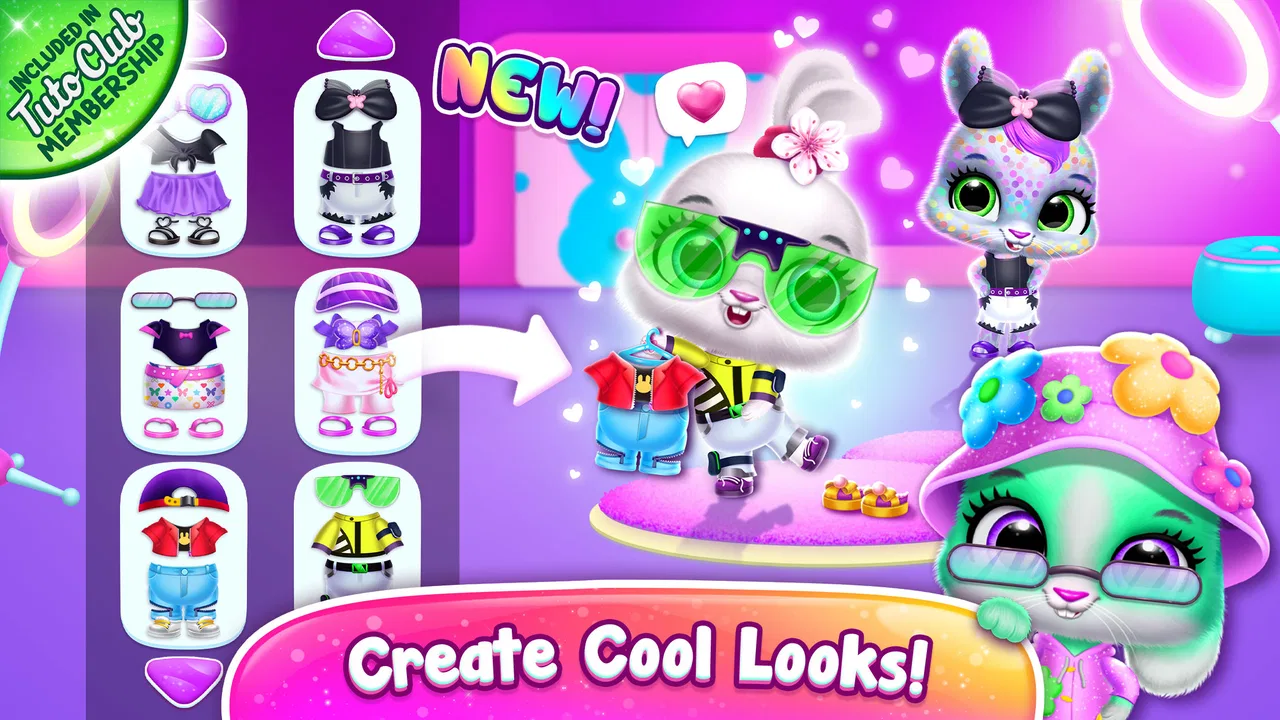
In Bunnsies - Happy Pet World, caring for your pets involves feeding them, playing games, and customizing their environment. The game provides various interactive activities to keep your pets happy, such as mini-games and decorating their living space. Regular interaction is key to ensuring your pets thrive.
Pros
- Engaging pet customization options.
- Colorful and vibrant graphics.
- User-friendly interface.
- Regular updates with new features.
- Suitable for all age groups.
Cons
- In-app purchases can be costly.
- Requires a stable internet connection.
- Some features need unlocking.
- Advertisements can be intrusive.
- Limited offline play options.

Bunnsies - Happy Pet World
Gallery